1 x 1 x mark: Shorty


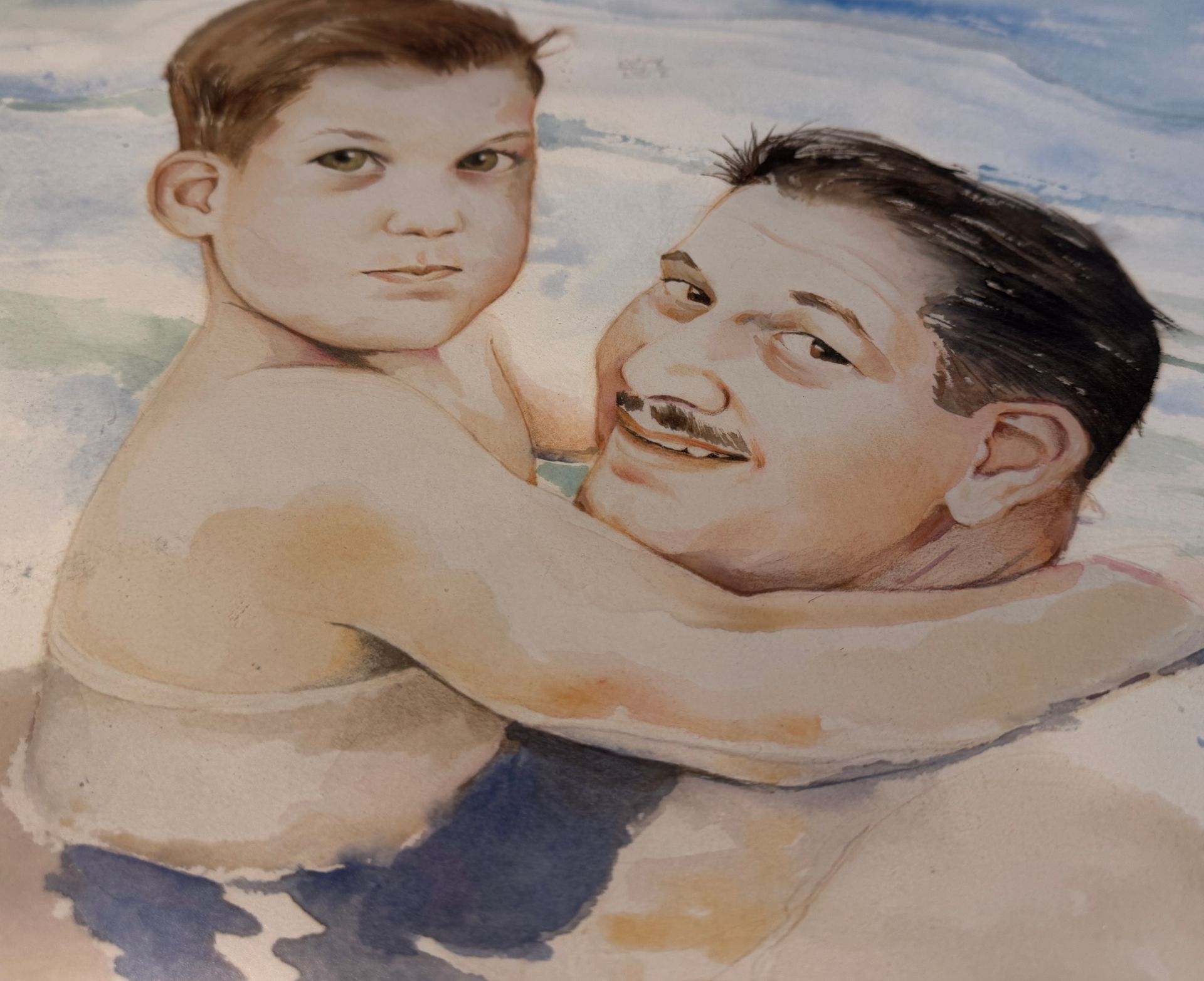
When I was little, my father sometimes called me Shorty. Only he did. And it wasn’t distant—it was the one word where something warm slipped out, a doorway into emotion he didn’t otherwise know how to show. He was a World War II veteran who held more inside him than he ever said aloud. Present, but not emotional. A provider, but not a go-outside-and-throw-a-football-with-me kind of dad. I learned early that I wanted things from him he didn’t know how to give.
So I watched him. Going to hardware stores. Coming home. Building, painting, fixing. Every time I asked, “Can I help?” he said, “No, you can watch.” And maybe that’s how I learned everything—by watching what he did, and even more by watching what he couldn’t show.
There was one soft memory: horror movies on the pull-out couch in our Bronx apartment. I hated them, but he put his arm around me. One night he carried me to bed, and I pressed my face into his neck, pretending to stay asleep so he wouldn’t put me down. Seventy years later, I can still feel that hallway under us. And one of the few times I remember seeing your real smile was in the water—at the pool or the lake—when I clung to you because I was scared, and you held me without a word.
But most of the time, when I asked what I should do, he’d say: “If you like it, I like it.” I didn’t want freedom. I wanted direction.
Near the end of his life, he was scheduled for a stress test. My suitcase was in the rental car outside the hospital. I stood beside his bed and finally asked the question I had carried my whole life: “Dad… do you want me to stay with you?” He looked at me—really looked at me—but even the wrinkles in his face wouldn’t give me an answer. “I cannot tell you what to do,” he said.
My throat tightened. I asked again, louder, choked up, almost pleading: “Do you want me to stay? Please tell me. I’ve wanted you to tell me what to do my whole life.” But again, he said softly, “I cannot tell you what to do.” I swallowed hard. “Okay then, I’m going to catch my flight. Good luck tomorrow.” That was the last face-to-face moment I had with him. He died two months later.
Years later, I’m standing on the Northern California bluffs where I live now, wearing his old Seabees jacket—finally fitting me. The air is cold, the Pacific endless, and my dog, a few steps away, sniffing in the wind. But the presence I feel beside me is my dad’s. I’m not looking across an ocean. I’m speaking to the long shadow quietly at my left.
“Dad… I’m sorry.” Sorry for expecting you to reach me in ways you didn’t know. Sorry for waiting for words you didn’t have—all those years waiting for you to say “I love you,” or “wait,” or “I’m sorry.” And as I stand here, speaking to you while looking out at the ocean, I realize: I could have said those words first. I could have opened the door I kept waiting for you to walk through.
The wind hits my face. Your jacket warms my whole being. The truth arrives: I learned how to be a father by watching everything you couldn’t show me—by listening to what you never said, by growing in the spaces where love had no instructions. You taught me more in your silence than any sit-down talk ever could have.
There’s one more thing. All through my childhood, you kept three books on the highest shelf. Weathered spines, carefully handled. I knew they were special because of how you touched them. After you died, I packed fast—because packing after a parent’s death is something you want to finish quickly. I grabbed the books without opening them. They traveled with me for decades, unopened. Only yours. Only your silence.
During lockdown, searching for an old photo, I finally pulled one out. It was The Decameron. A book about a plague, isolation, and a hundred tales told to survive. Days later, The New York Times wrote about why Decameron suddenly matters again. I looked up and said: “Dad… you meant for me to find this now.” I read it with you on every page.
Today is your birthday. So this is my little one-by-one for you. Thank you, Dad—for what you gave and for what you couldn’t. Thank you for the jacket, the books, the walk down the hallway, the ginger ale on the rocks, the quiet love hidden in your silence, and for teaching me how to be a dad without the sit-down instructions. I carry all of it. And with one deep breath, I let all of it carry me. I love you, Shorty.